Photo: Hamdigumus (CC0)
Walk the city Mausolus built and Bodrum inherited — the foundations of the Mausoleum, one of the Seven Wonders of the Ancient World; the Castle of St Peter that the Knights Hospitaller raised from its fallen marble; the Museum of Underwater Archaeology with the Uluburun shipwreck; the ancient theatre above the harbor; the Myndos Gate where Alexander's night assault failed; and the sponge-diving waterfront that made modern Bodrum. GPS-triggered narrations at 20 points.
20 narrations, yours to keep — no subscription, no expiry. Works offline once downloaded, and if it isn’t for you we’ll refund it.
Going somewhere with no signal? Download on wi-fi before you set off — keep the screen open while it saves — then add it to your home screen so you can find it again. It works in airplane mode, with no roaming charges. Show me how to save it →
Arriving by cruise ship? Bodrum cruise port guide — hours ashore, distance from the berth, directions.
Every claim in this tour traces back to a named source — excavation records, the heritage authority for the site, and the primary texts themselves. Nothing is copied from other guidebooks, and anything we can't source doesn't make the recording.
Each stop is built from OpenStreetMap · 27 features in this old town (the field-surveyed mapping database behind Apple Maps), Wikidata · 9 cross-referenced entries (peer-reviewed structured records), the heritage authority below, and the primary historical texts where they exist.
Cross-referenced against Modern excavation publications · academic peer-review.
Every sentence is checked against those sources before it is recorded. If a claim can't be traced, it doesn't make the audio.
The major stops trace back to specific passages in Strabo's Geography, and Arrian's Anabasis of Ale, cited stop by stop.
Every tour is reviewed by a person before it goes on sale. Stop selection, the route and anything ambiguous come back to the editor for a decision, and those questions routinely send a stop back for another accuracy pass. Nothing publishes on a machine’s say-so.
Spot anything inaccurate? Email [email protected] — fixed in the next pass.
The foundations of the tomb that named all mausoleums — one of the Seven Wonders — with the ancient theatre on the Göktepe slope and the Temple of Mars above the town.
The Knights Hospitaller fortress on the harbor islet, built from the Mausoleum's quarried marble — its chapel, its towers of the langues, and the Museum of Underwater Archaeology with the Uluburun wreck.
The western gate where Alexander's night assault broke in 334 BC, the 4th-century twin graves, and the hilltop resting place of the Fisherman of Halicarnassus.
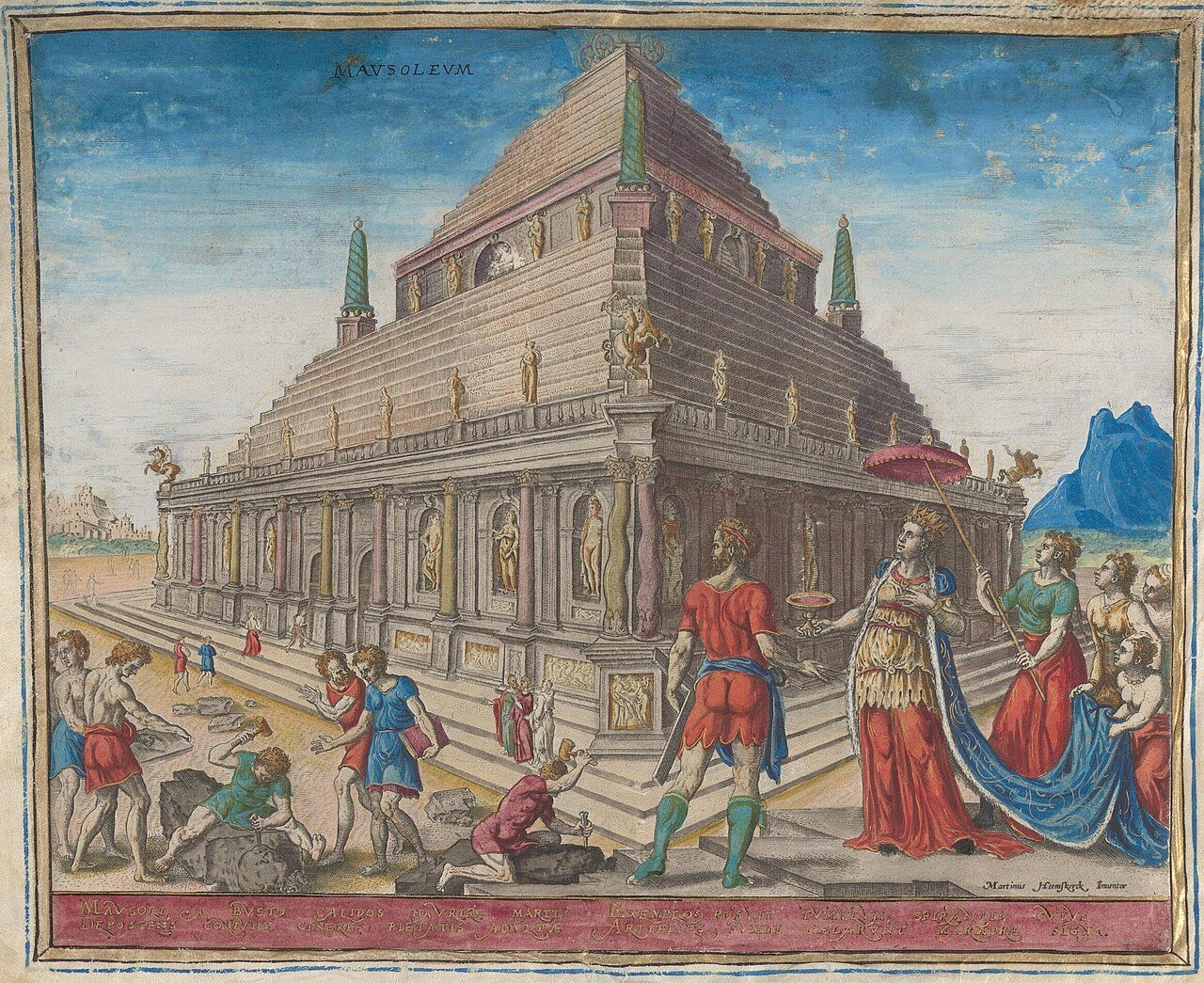
The tomb of Mausolus, completed by his sister-wife Artemisia II — one of the Seven Wonders of the Ancient World, its sculptors named by Pliny, its marble later quarried by the Knights for their castle.
The Knights Hospitaller fortress on the harbor islet, its towers named for the langues of England, France, Italy and Germany — surrendered to the Ottomans in 1523 after the fall of Rhodes.
Inside the castle: the Uluburun shipwreck — the oldest excavated seagoing ship in the world — the Serçe Limanı glass wreck, and the tomb of the Carian Princess.
Mausolus's theatre cut into the Göktepe slope above the harbor — the centerpiece of the city Vitruvius describes as curving like a theatre around its bay.
The western gate of Mausolus's walls, where Alexander's night assault was thrown back in 334 BC — the moat before it still holds the story Arrian recorded.
The western headland of the fountain whose waters, Ovid says, joined Hermaphroditus and the nymph Salmacis into one being — site of the famous Salmakis inscription.
Tap "Start Walking Tour" and allow location access. The map shows all 20 narration points.
Follow the suggested route or explore freely. GPS tracks your position. Reach a site and the narration plays automatically.
Each site has its own narration — history, archaeology, and stories brought to life. 20 narration points across the full tour.
Narrations play when you reach each site. No buttons, no track numbers. Walk naturally — the stories find you.
Premium narration that sounds like a documentary. Warm and knowledgeable, not a textbook reading.
Every narration is drafted, cross-checked against primary sources, then passed through a second editorial pass that strips unsupported claims. Dates, names, and citations verified.
See all narration points on the map. Tap any point to hear it early or replay it later.
Every significant point from the Mausoleum to the waterfront. Major monuments get deep dives; the gates, tombs, mosques, and monuments get focused stories.
Spend an hour or a full day. Skip sites, revisit favourites, take breaks. The tour adapts to you.
20 narration points, including Mausoleum of Halicarnassus, Myndos Gate, Diver, Ottoman Shipyard and Temple of Mars. That is about 49 minutes of narration in all, and you walk between the stops at your own pace.
Yes. It plays in your phone’s browser as you walk: no guide, no group, no app to install and no fixed start time.
Yes, from Bodrum. There is no start time and no group to keep up with, so you can stop at any point and head back to the ship. Keep your own eye on the all-aboard time.
Three ways, all built in:
The map-tap option means you can stand anywhere — even at home before you travel — and play any narration. GPS just makes it hands-free while you’re actually walking the site.
No. Use the “Download for offline” button before you go, and the entire tour — audio, maps, narration text — works without any data connection. Tap-to-play and the map both work fully offline. GPS itself doesn’t need data; only the download does.
Add the icon first, then download from the icon. On iPhone a guide downloaded in Safari cannot be seen by the home screen icon, so downloading first means downloading the whole thing twice.
Putting it on your home screen — iPhone or iPad (Safari):
On Android (Chrome): tap the three-dot menu at the top right, tap Add to Home screen (some phones say Install app), then confirm. On Android either order works.
If you opened this link from inside Instagram, Facebook or Gmail, you are in that app’s built-in browser. It cannot add anything to your home screen, and a guide downloaded there is thrown away when the app closes. Open the link in Safari or Chrome first.
Two backstops. First, the map shows every site — just tap the marker for the place in front of you. Second, you can manually queue any narration even when GPS is off. The platform never assumes GPS works; it’s the convenience layer, not the gate.
The audio runs ~2–2.5 hours total, but you walk at your own pace. 20 narration points across the site. Most visitors take 2–4 hours; some spread it over multiple visits. Once you buy it, it’s yours — there’s no expiry and no subscription. Come back next year if you like; the link in your receipt always works.
One purchase covers one device session. Most couples share earbuds and use a single phone — the audio is paced for that. If you want everyone listening on their own device, each person needs their own purchase. We do not gate sharing aggressively; we trust visitors to do the right thing.
Full refund if you never trigger a single narration on-site. Partial refund based on how far you got. See the refund policy for specifics.
The ancient-city narrations anchor to the classical sources: Herodotus — Halicarnassus's own historian, born here around 484 BC — Vitruvius's De architectura on Mausolus's planned city, Pliny the Elder's Natural History on the Mausoleum and its sculptors, Strabo's Geography, and Arrian's Anabasis of Alexander on the siege of 334 BC. For the Castle of St Peter, the narrations follow the histories of the Knights Hospitaller and the excavation records of the Bodrum Museum of Underwater Archaeology, which administers the castle. The Mausoleum accounts draw on Charles Newton's 1856-58 excavation for the British Museum and the Danish Halikarnassos Project.
GPS-triggered audio tours for heritage sites worldwide.